

Construction Debris Removal in Orange County: Tile, Drywall, Concrete, Roofing & Remodel Cleanup (2026)
Last updated: March 1, 2026
Remodeling feels productive until you’re staring at a pile of debris that’s sharp, dusty, heavy, and annoying to get rid of.
And here’s the part most people learn the hard way: construction debris isn’t “regular junk.” A “small” tile pile can weigh more than a couch, disposal rules can get picky, and what should be a simple cleanup turns into an all-day dump run.
This guide is for Orange County homeowners, landlords, flippers, and DIY remodelers who want debris gone without wrecking their back, their vehicle, or their weekend. You’ll learn:
- what counts as construction debris (and what doesn’t)
- Orange County dump rules that trip people up
- materials that cost more (and why)
- DIY vs dumpster vs professional haul-away
- how to prep your pile so pickup is fast and clean
The 10-Second Reality Check (Before You Choose DIY)
If your debris is mostly tile, mortar/thinset, concrete, plaster, roofing, brick, or soil, DIY stops being “cheap” fast.
Why? Because the job becomes weight + labor + disposal rules, not just “truck space.”
Quick Chooser: What’s the Smart Move?
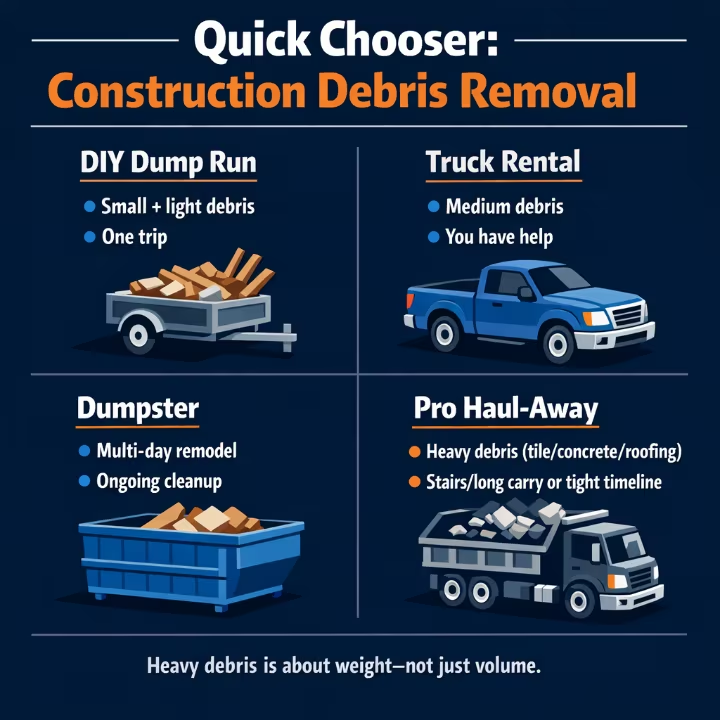
DIY dump run makes sense if:
- It’s mostly light material (trim, packaging, small drywall, carpet/pad)
- It fits in one trip
- No stairs / long carry
- You can load it safely
Dumpster rental makes sense if:
- You’re remodeling over multiple days
- You want ongoing cleanup
- You have room to place it (driveway) without HOA / right-of-way issues
Professional haul-away makes sense if:
- It’s heavy (tile/concrete/plaster/roofing/soil)
- You have stairs, long carry, tight access
- You want it gone fast (inspection, turnover, move-out)
- You don’t want dust + nails + rubble destroying your vehicle
Fast rule: If you wouldn’t want to carry it in a 5-gallon bucket more than 10 times, don’t DIY it.
What Counts as Construction Debris?
Common Orange County remodel debris:
- Tile + mortar + thinset + grout
- Drywall + plaster + lath
- Concrete chunks, pavers, brick, block
- Wood scraps, trim, baseboards
- Cabinets, vanities, shelving
- Flooring (vinyl, laminate, carpet, pad)
- Roofing debris (asphalt shingles, underlayment, nails)
- Mixed demo piles (a bit of everything)
Orange County Dump Rules That Matter (This Saves You Headaches)
These are the exact “gotchas” that make people get turned away or pay more than expected.
Before you load up, check OC Landfills’ “What Can I Take to the Landfill?” list so you don’t waste a trip.
1) OC landfills only accept waste that originated in Orange County
You may be asked for proof of residency / proof of job location / proof of origin. If your debris didn’t come from Orange County, expect problems.
(Also: rules can change — call ahead if you’re unsure.)
2) Bowerman Landfill is commercial-only (no public disposal)
If you’re a homeowner planning a dump run, don’t assume you can use every landfill. Some sites are commercial-only, and you’ll need commercial status documentation.
3) Treated wood has special rules (and it’s not accepted everywhere)
Pressure-treated lumber (posts, decking, timbers, railroad ties, etc.) is handled differently:
- accepted only at certain facilities
- requires paperwork (manifest)
- can’t be mixed into regular debris
- coated/painted treated wood may be rejected
Translation: don’t bury treated wood in the pile “hoping it’s fine.” It can delay the whole load.
If you suspect pressure-treated lumber, follow OC Landfills’ treated wood disposal rules (separate it, don’t mix it, and note that coated/painted treated wood isn’t accepted).
4) Soil isn’t “just dirt” if it’s a larger load
If you’ve got soil/dirt and it’s beyond a certain size/weight, it may require an approval process and lab testing before it’s accepted.
So if your project includes excavation, plan for that early.
5) Asphalt has its own rules (and “free days” change)
“Asphalt” can be classified differently depending on contamination (ex: petromat/rebar) and the rules at that facility. Also, what was “free” in the past may not be free now.
6) Some items people toss into debris aren’t accepted at landfills
Common ones:
- tires
- hazardous waste (paint/chemicals/fuel)
- certain appliances depending on who you are (resident vs commercial)
Bottom line: construction debris is doable — but you want clean piles and the right routing, especially in Orange County.
Materials That Usually Cost More (and Why)
This is where people get surprised.
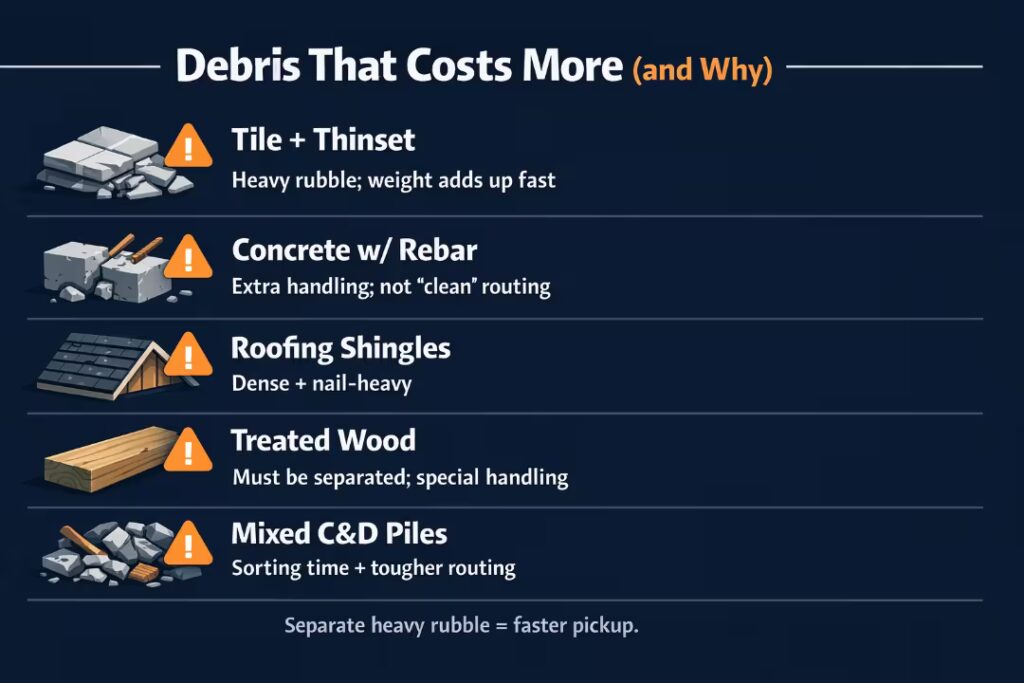
Tile + mortar/thinset
Looks small. Weighs a ton. Heavy rubble = higher labor + higher disposal cost.
Concrete with rebar / wire mesh
Concrete itself can be recyclable as “clean inert,” but rebar/mesh can create extra labor because many recyclers want it cut flush / sized. If rebar is sticking out, it can add cost or get rejected by certain recycling routes.
Roofing tear-off (shingles + underlayment + nails)
Roofing is dense, dirty, nail-heavy, and stacks weight fast. Even when volume looks “medium,” the load can be heavy.
Treated wood
Special handling rules, must be separated, paperwork can be required, and it may be rejected if it’s coated/painted.
Mixed C&D (everything together)
Mixed loads take longer to load and are harder to route. Separation is one of the easiest “ROI” moves you can make.
Soil (larger loads)
May require approval/testing — and it’s heavy, which increases cost quickly.
Quick Disposal Routing (OC Reality Check)
- Clean concrete / pavers: easiest when it’s truly clean and staged in one pile.
- Concrete with rebar/mesh: expect extra handling—cut/contain rebar when possible.
- Roofing shingles: dense + nail-heavy; keep it separated and staged.
- Treated wood: keep separate (special handling rules).
- Paint/chemicals/batteries: do not mix—use OC HHW centers instead.
The “Before You Haul” Checklist (Do This and You’ll Save Money)
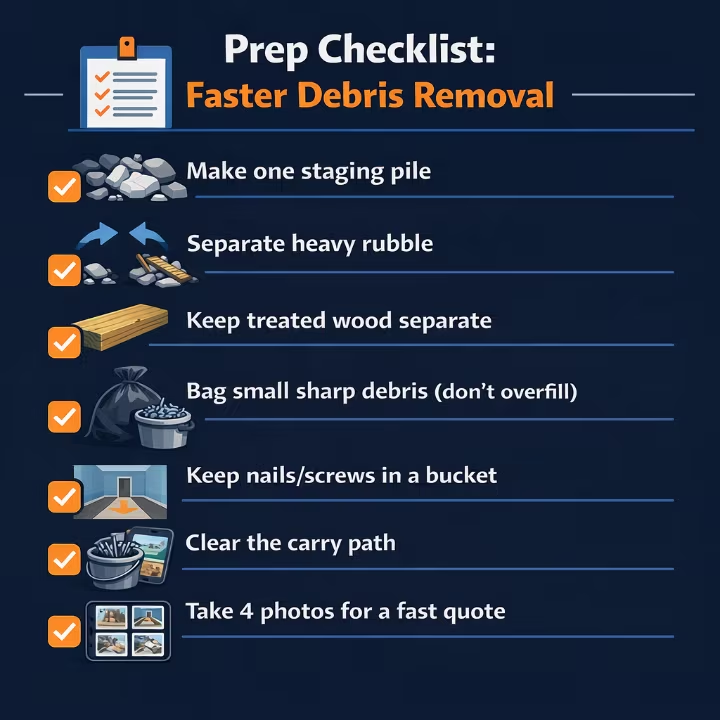
If you want removal to be fast (and avoid extra labor/time), do this:
1) Make one staging area
Put everything in one pile near the easiest exit (driveway/garage is ideal).
2) Separate heavy rubble from light debris
If you can, split into:
- Pile A: heavy rubble (tile/concrete/plaster/roofing/soil)
- Pile B: light/mixed (wood, drywall, trash)
3) Keep treated wood separate
If you suspect it’s pressure-treated, keep it separate.
4) Keep hazardous/universal waste out of the pile
Paint, chemicals, fuel, batteries, fluorescent tubes, etc. do not belong in a normal debris load.
5) Contain sharp items
Nails/screws in a bucket. Metal scrap in its own pile.
6) Bag small broken pieces (but don’t overfill)
Contractor bags are great until you overfill them and they explode.
7) Control dust
Drywall/plaster dust travels. Stage near the exit; don’t drag it through clean areas.
8) Plan access and parking
Stairs, long carry, narrow gates, tight parking = time multipliers.
9) Take photos before you request a quote
Fast quotes happen when you send:
- wide shot of the pile
- close-up of materials
- access path (stairs/gate/hallway)
- where the truck can park
Your Options for Construction Debris Removal in Orange County
Option 1: DIY Dump Run (Car/SUV)
Best for: small, light debris only.
If you’re using a car/SUV:
- tarp everything
- keep sharp items contained
- don’t pretend tile is “fine” in a trunk
Option 2: DIY Dump Run (Truck Rental / Pickup)
Best for: medium piles when you have help and decent access.
Bring:
- gloves, eye protection, dust mask (drywall/plaster)
- wheelbarrow (rubble)
- straps (loads shift)
- broom (dust stays behind)
Reality: heavy debris loads slow. Multiple trips add up fast.
Option 3: Dumpster Rental
Best for: remodels over multiple days.
Pros:
- ongoing cleanup while you work
- keeps the site cleaner
Cons:
- you still load everything
- weight adds up fast with tile/concrete/roofing
- placement/permits/HOA rules can be annoying
Option 4: Professional Construction Debris Haul-Away (Done-for-You)
Best for: heavy rubble, roofing, mixed demo, stairs/long carry, tight timelines.
We load it, haul it, and route disposal properly so you don’t do multiple trips or guess the rules.
This is usually the best ROI when:
- the pile is heavy
- access is annoying (stairs, long carry, gated)
- you need it cleared fast (inspection/turnover)
What Drives Price for Construction Debris Removal?
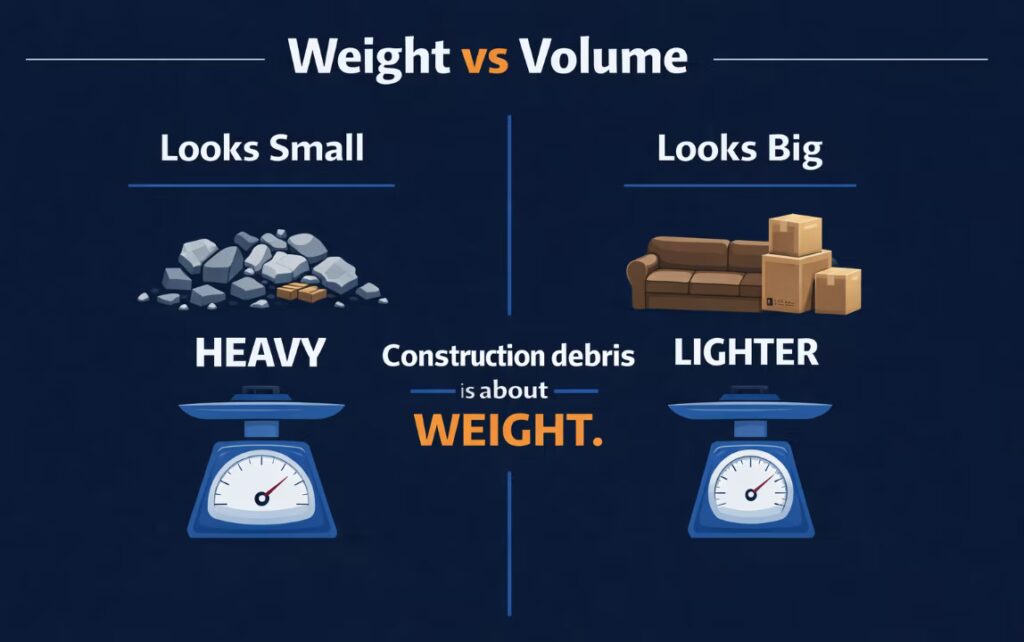
No gimmicks — it usually comes down to:
- Weight (biggest driver)
- Volume (truck space)
- Labor time (stairs, long carry, sorting, tight turns)
- Access + parking
- Material type + separation (clean piles are easier than mixed)
Same-Day Construction Debris Pickup in Orange County
Same-day is doable, but these make it harder:
- heavy rubble (tile/concrete/soil)
- stairs or long carry
- gated communities + strict parking
- condo rules / elevator reservations
- mixed debris spread across multiple rooms
If you want same-day, send photos + keep a usable time window.
Real Scenarios (So You Choose the Right Option)
Scenario A: Small bathroom refresh (some drywall + trim)
DIY is fine if it’s light and staged.
Scenario B: Flooring demo (tile + thinset)
DIY “savings” often disappear here. Heavy rubble is slow to load and expensive to dump.
Scenario C: Kitchen demo (cabinets + mixed debris)
Dumpster works if you’re demo’ing over days. Pro haul-away is best if you need it cleared immediately.
Scenario D: Concrete chunks with rebar
If rebar is sticking out, expect extra labor. Cutting it flush / keeping the load clean improves routing and cost.
Scenario E: Roofing tear-off (shingles + nails)
Dense, nail-heavy, and stacks weight fast. Keep it staged and separate when possible.
Quick FAQs
About OC Bros
We’re a licensed and insured local team serving Orange County. We specialize in construction debris haul-away and remodel cleanups — including tile, drywall, concrete, roofing tear-off, cabinets, and mixed demo piles. We keep it simple with flat-rate pricing, clear communication, and no surprises.
Next Step
- Want to DIY part of it? Separate heavy rubble (tile/concrete/roofing) from light debris and stage everything in one area near the easiest exit. It makes dumping or pickup way easier.
- Want it gone fast (or it’s heavy/stairs/long carry)? Text a few photos and your city to (657) 776-2336 for a flat-rate estimate and a clear plan.
Ready to get rid of construction debris?
Skip the dump run hassle. Text photos of the debris pile to (657) 776-2336 and we’ll tell you the fastest, most cost-effective option — whether that’s haul-away, a dumpster plan, or a staged pickup anywhere in Orange County.
Licensed, insured, and locally trusted. Use our instant cost calculator below for a quick estimate.
Takes less than 2 minutes • No name, email, or credit card required