

No Truck, No Problem: Move “Pickup-Only” Estate Sale Deals & Flip Them (2026)
Last updated: March 1, 2026
Flipping large estate sale items isn’t hard because the pieces are rare. It’s hard because most people can’t move them.
This guide shows you how to win “Pickup-Only” deals without owning a truck — using logistics, profit math, and risk rules that actually work.
- How last-day estate sale markdowns typically work (often 30–50% off)
- Which transport option makes sense (rental, helper, delivery platforms, movers)
- How to calculate your max offer so you don’t lose money
- What to confirm before you buy (pickup window, stairs, parking, carry distance, disassembly, who loads)
- How to price delivery to sell faster without killing margin
Profit = Sale price − (Buy price + Transport + Supplies + Fees + Time + Risk)
You do not need to own a truck to play this game. You need a system for logistics, pricing, and risk. This guide gives you exactly that.
Want a printable pickup checklist? Use our Estate Sale Pickup Checklist before you pay (stairs, parking, carry distance, tools, who loads).
What you’ll learn
- The easiest large estate sale items to flip (and which ones to avoid)
- A simple decision system to choose the right transport option every time
- The real cost categories behind rentals, helpers, delivery apps, and movers
- A max-offer formula that protects your profit
- Delivery pricing tiers that speed up sales without killing margin
- Pest and damage-risk rules that prevent expensive mistakes
- Last-day estate sale strategy to save money
- A repeatable weekend workflow so you stop “winging it”
Quick answers (for pickup-only deals)
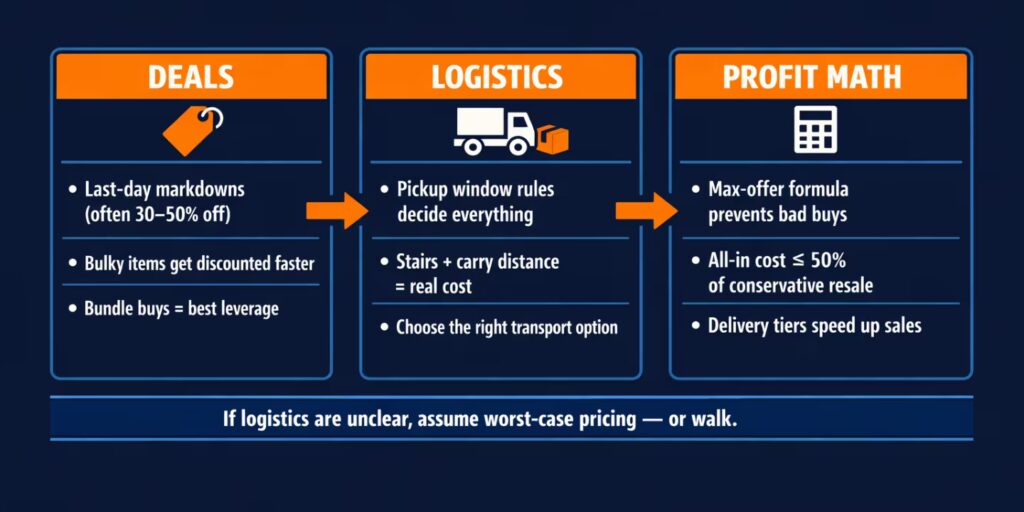
- Cheapest option: rent a pickup/van if loading and access are simple
- Safest option: “truck + muscle” delivery when stairs, tight turns, or heavy pieces are involved
- Deal rule: if you must pay for transport, keep your all-in cost at 50% or less of conservative resale
- Max offer: resale − (transport + supplies + fees + your time + profit buffer)
- Strict pickup window: don’t buy unless transport is already planned
The 10-second reality check
If your flip requires transportation, your profit is not “buy price vs sell price.”
Your real profit is:
Profit = Sale price − (Buy price + Transport + Supplies + Fees + Your time cost + Risk)
Large items come with more silent costs than small flips, so you need wider spreads. A solid baseline rule:
If you must pay for transport, try to keep your all-in cost at 50% or less of your conservative resale price.
That margin covers the reality of bulky flips: extra time, no-show buyers, hidden damage, and occasional losses.
Quick chooser: pick your flipping lane
Lane A: The no-logistics lane (simple, lower upside)
This lane is for you if you want minimal moving risk.
Buy only items that:
- Fit in a car, SUV, or minivan with doors closed, or
- Break down easily, or
- Can be moved safely with a standard dolly by one person
Lane B: The logistics lane (bigger discounts, higher upside)
This lane is for you if you want the best deals.
Target items other buyers avoid because of:
- Size
- Weight
- Stairs
- Awkward shapes
- “Pickup only” sellers
This post is built for Lane B.
The decision system: how to flip big items without owning a truck
Use this every time before you commit.
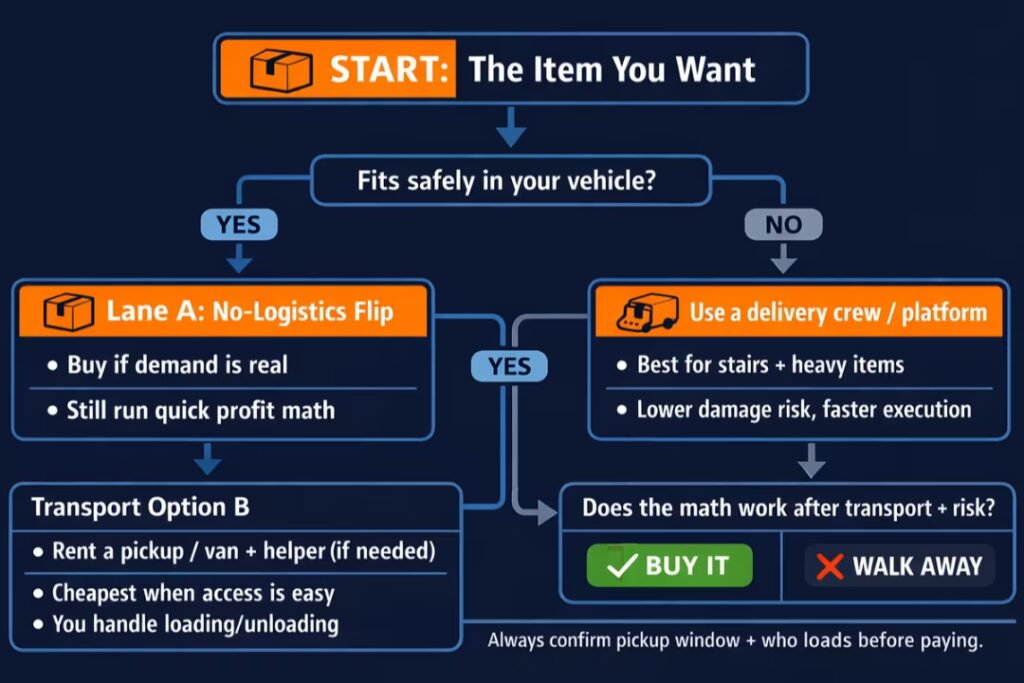
Step 1: Can the item fit safely in your vehicle?
Yes: you’re likely in Lane A for this item. Proceed if demand is real.
No: go to Step 2.
Step 2: Is the item bulky/heavy, or is access annoying?
Examples:
- Stairs
- Narrow hallways
- Tight parking
- Condo elevators
- Long carry distance
Yes: assume you’ll need paid help or a delivery platform. Go to Step 3.
No: you may be able to use a rental pickup/van with minimal help. Go to Step 3 anyway.
Step 3: Choose the transport option
- If you can lift it safely with one other person: rental pickup/van + helper
- If you cannot lift it safely or access is hard: on-demand delivery platform or movers
- If you’re doing multiple pickups in one day: longer rental block or a scheduled delivery team
Then do the math. If the math doesn’t work, walk away.
For rentals, check current pricing and requirements: U-Haul truck rentals and Home Depot truck rental .
Transport options that actually work (no truck needed)
Prices vary by city, day, and distance. What matters is picking the option whose cost structure matches the job.
Option 1: Rent a pickup or cargo van (you do the driving)
Best for: one or more local pickups, short distances, simple access.
Typical cost drivers:
- Rental duration
- Mileage rules
- Fuel
- Deposits/taxes
- How organized you are (time is money)
This is usually the cheapest route if you can handle loading and unloading safely.
Option 2: Rent a truck and hire a helper (labor + rental)
Best for: heavy pieces, awkward carries, stairs, or when you’re solo.
Cost drivers:
- Local hourly rates
- Number of helpers
- Carry distance and stairs
- Speed of your staging/loading plan
This route is often the best balance of cost + control when you can’t do it alone.
Option 3: On-demand “truck + muscle” delivery services
Best for: hard access, heavy items, and clean execution.
Cost drivers:
- Distance
- Number of items
- Stairs
- Time on site
- Disassembly/tight navigation
This option can cost more, but it can dramatically reduce damage risk and your physical workload.
Option 4: Traditional local movers
Best for: high-value pieces, multi-item moves, or complex access.
Often overkill for a single dresser. Smart for:
- Multiple items
- Fragile antiques
- Long carry + stairs
- Strict buildings with reservations/rules
Option 5: Longer-distance or multi-stop rentals
Best for: multi-city pickups or long routes.
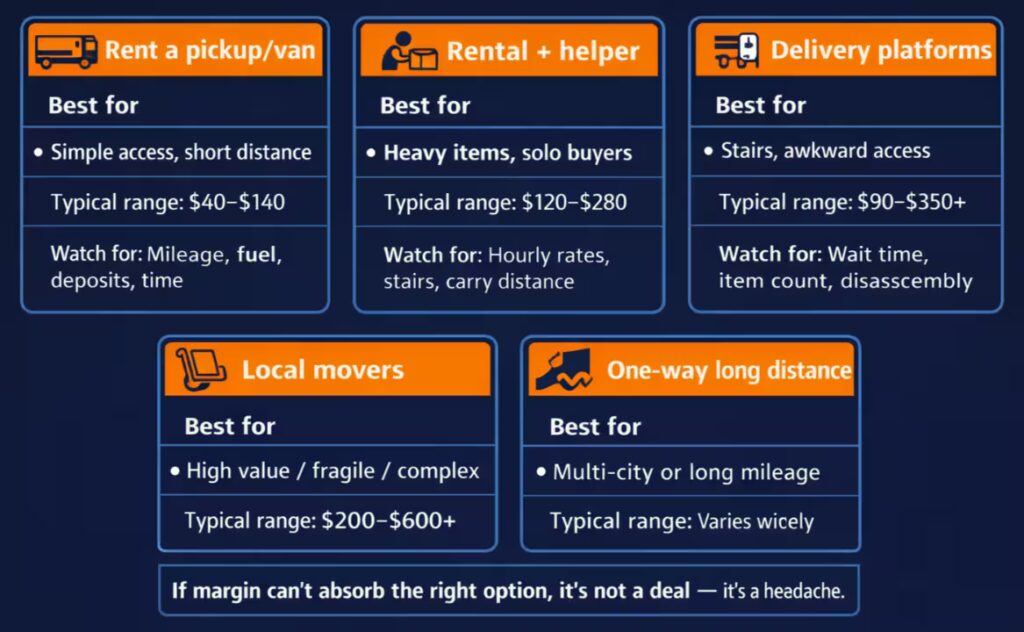
The value here is mileage control and route efficiency, especially when you’re batching pickups.
Price comparison: pick the smartest move
Use this mental table before you commit.
- One large item, simple access, short distance: rental pickup/van (lowest cost)
- One large item, you need help lifting: rental + helper (safer, controlled cost)
- Stairs, tight turns, awkward item: truck + crew (faster, less damage risk)
- Multiple pickups in one day: longer rental block (lower cost per item)
- High-value fragile piece or complex building: movers (best risk control)
If your expected margin can’t absorb the correct transport option, it’s not a deal. It’s a headache.
The pickup-window playbook (estate sale insider)
Here’s the part most flipping posts ignore: estate sales and many “pickup only” situations run on tight pickup windows. If you show up late, unprepared, or without muscle, you lose the deal.
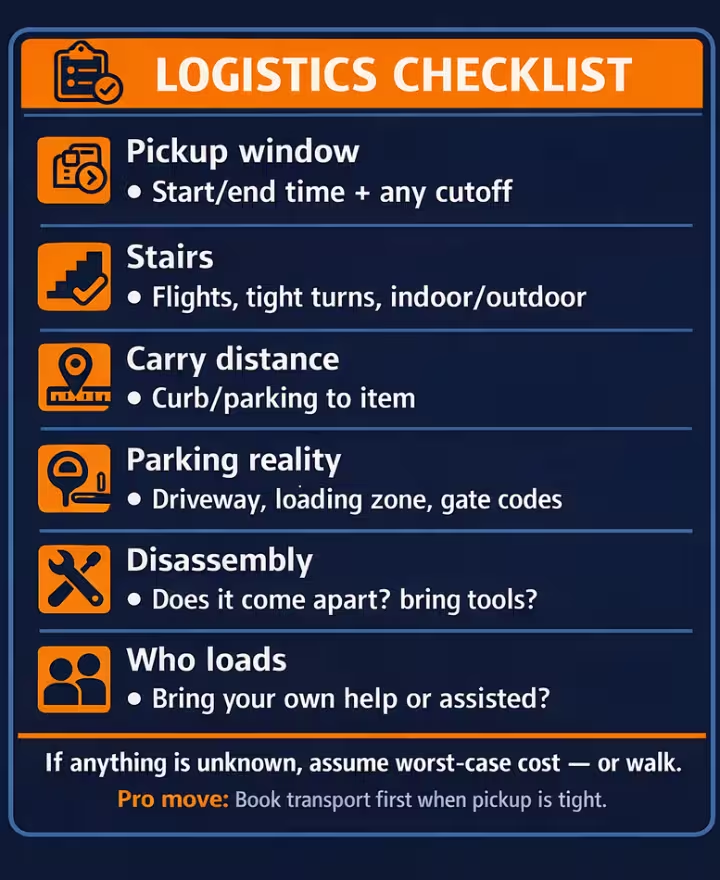
Before you buy, confirm these 6 things:
- Exact pickup window (start time, end time, any cutoff)
- Stairs (how many flights, indoor/outdoor, tight turns)
- Carry distance (curb/parking to the item)
- Parking reality (driveway, loading zone, street parking, gate codes)
- Disassembly needs (does it come apart, do you need tools?)
- Who loads (is it “bring your own help” or do they assist?)
Rule: If any of these are unknown, assume worst-case and price accordingly, or walk.
Pro move: When pickup is tight, book transport first and negotiate second. You win because you can execute cleanly.
The max-offer formula (this prevents bad buys)
Before you negotiate, set your maximum buy price. Use this:
Max offer = Conservative resale price − (Transport + Supplies + Fees + Your time cost + Profit buffer)
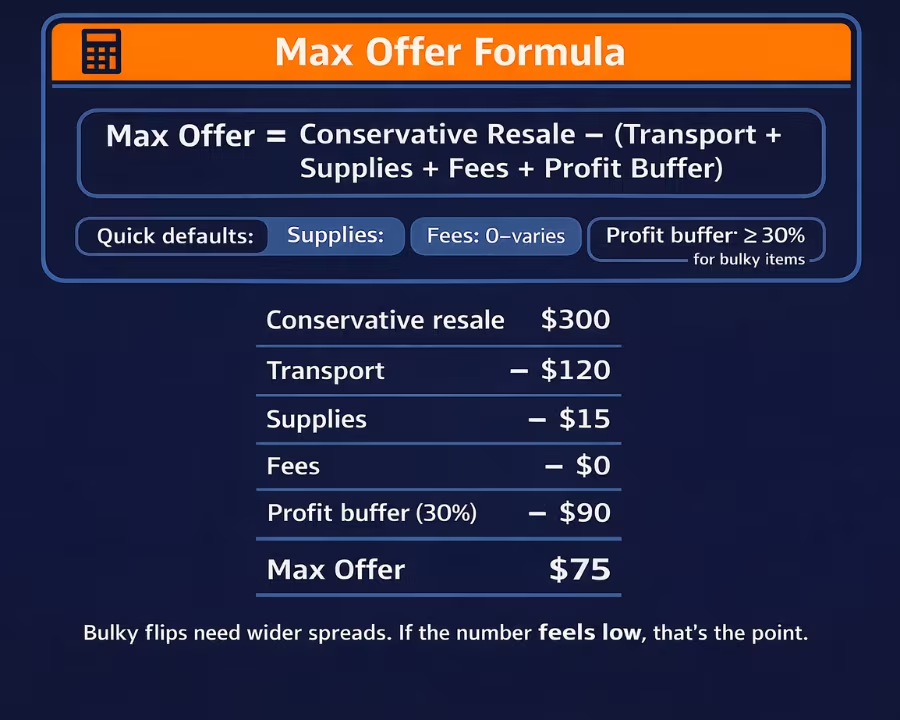
Max Offer Calculator
Quick defaults:
- Supplies: $10 to $25 per item (wrap, pads, straps, cleaning basics)
- Fees: $0 for many local cash sales, higher on fee platforms
- Time cost: your hours × your hourly value (optional but recommended)
- Profit buffer: at least 30% of resale price for bulky items
- Go 35–45% when stairs, tight access, upholstery risk, or fragile pieces are involved
Example (simple and blunt)
- Conservative resale: $300
- Transport: $120
- Supplies: $15
- Fees: $0
- Profit buffer: $90 (30% of $300)
Max offer = $300 − ($120 + $15 + $0 + $90) = $75
That number might feel low. That’s the point. Bulky flips need margin.
Three real scenarios (copy the math, avoid regret)
Scenario 1: Dresser flip (simple access, rental + helper)
Conservative resale: $350
Plan: rental pickup/van + one helper, driveway pickup
Costs:
- Transport (rental + fuel/mileage): $95
- Helper (1.5 hours): $75
- Supplies: $15
- Fees: $0
- Profit buffer (30%): $105
Max offer = $350 − ($95 + $75 + $15 + $0 + $105) = $60
If you can’t buy it around $60, this deal is thin. Don’t force it.
Scenario 2: Dining table (stairs/tight access, delivery crew)
Conservative resale: $650
Plan: truck + crew because of stairs and awkward carry
Costs:
- Delivery/crew: $220
- Supplies: $25
- Fees: $0
- Profit buffer (30%): $195
Max offer = $650 − ($220 + $25 + $0 + $195) = $210
Tables photograph well and sell fast when priced right. This is a “yes” when the pickup can be executed cleanly.
Scenario 3: Multi-pickup day (3 stops, longer rental block)
Conservative resale total: $1,050
Plan: 4–6 hour cargo van rental + one helper for the route
Costs:
- Rental block + fuel/mileage: $160
- Helper (4 hours): $160
- Supplies: $30
- Fees: $0
- Profit buffer (30%): $315
Max offer total = $1,050 − ($160 + $160 + $30 + $0 + $315) = $385
Route rule: multi-pickups only work when you batch them. Renting for one small item at a time is how you bleed margin.
What to flip: easiest large items to resell
Your “yes list” should prioritize three traits:
- High demand
- Easy to photograph and describe
- Durable materials with low return risk
Strong categories for no-truck flippers
- Solid wood dressers and chests (clean fronts, good hardware)
- Dining tables that separate from the base
- Dining chair sets (pairs and sets sell well)
- Nightstands (fast-moving, easy buyers)
- Mid-century style pieces (great photos = strong clicks)
- Metal storage cabinets and tool chests (condition matters)
- Patio sets if frames are solid and cushions are cleanable
- Gym equipment with simple mechanics (avoid fancy electronics unless you can test)
Items to avoid until you’re experienced
- Particleboard pieces with swelling/peeling/water damage
- Huge armoires that don’t break down
- Mattresses (skip)
- Pianos, safes, hot tubs (specialty moving, high risk)
- Large upholstered sectionals (risk for pests, odors, stains)
The risk you cannot ignore: pests and upholstery
Secondhand upholstery can be profitable, but one bad pickup can wreck your operation.
Professional rule:
- If you’re new, focus on hard goods first.
If you buy upholstery:
- Inspect seams, folds, underside, and corners carefully
- Don’t bring it directly into your home without a plan
- Price the risk into the deal (higher buffer, lower max offer)
If you’re unsure, refer to these as a baseline when checking upholstery: CDC bed bug prevention tips and EPA bed bug guidance .
Inspection checklist (5 minutes that saves you money)
When you show up, don’t “fall in love” with the piece. Verify risk.
- Structure
- Wobble?
- Split joints?
- Cracked legs?
- Bad repairs?
- Drawers and doors
- Smooth slides?
- Doors align?
- Hinges loose?
- Hardware missing?
- Water damage
- Check corners and underside
- Feel for swelling or soft spots
- Odor check
- Smoke odor is a resale killer
- Musty smell often means moisture problems
- Transport reality
- Will it clear doorways?
- Does it disassemble?
- Do you have straps/pads/tools?
- Is there a safe path to the truck?
If any of these are bad, your price must drop or you walk.
Move and protect like a pro (the basic kit)
Minimum kit:
- Dolly/hand truck
- Moving blankets or furniture pads
- Stretch wrap
- Ratchet straps
- Work gloves
- Basic tool kit (screwdriver, Allen keys, adjustable wrench)
- Corner protectors (optional but helpful)
This prevents the most common expensive mistake: damage during transport.
How to price delivery (so you sell faster without killing profit)
Offering delivery expands your buyer pool and reduces “can you hold it” conversations. But don’t guess.
Use tiered delivery pricing. Keep it consistent.
Tier 1: Curbside or driveway drop
- No stairs
- Short carry
- Basic placement
Tier 2: Inside delivery
- One flight of stairs or long carry
- Tight turns or parking constraints
Tier 3: White-glove delivery
- Multiple flights
- Assembly
- Removal of old item (only if you’re equipped)
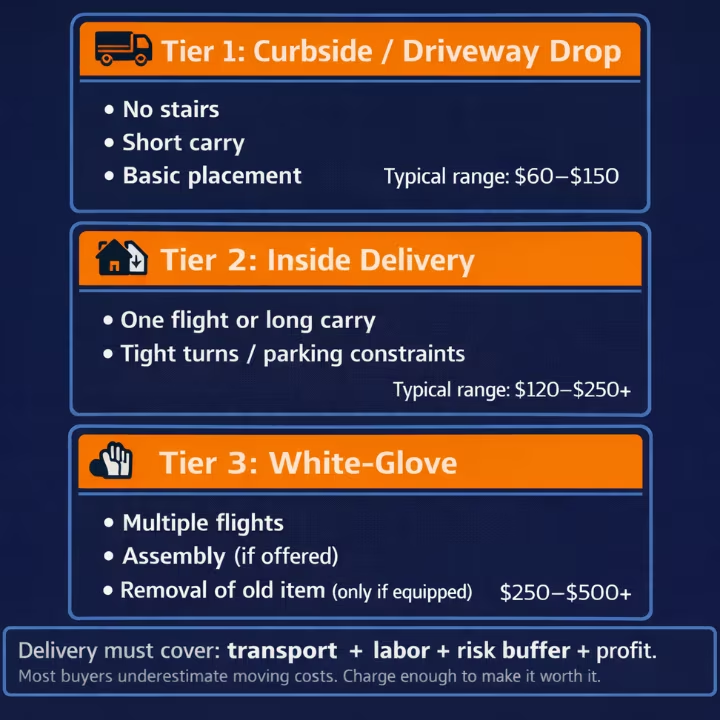
Delivery pricing rule that protects you:
Delivery price must cover transport cost + labor cost + risk buffer + profit.
If a buyer says delivery is “expensive,” that’s normal. Most people underestimate what moving actually costs. Your job is to charge enough to make it worth it.
Scam-proof your deals (basic rules)
Don’t get cute. Keep it clean.
- Don’t send verification codes
- Don’t accept weird overpayment stories
- Don’t trust screenshots as “proof”
- Keep payment and pickup simple
- If something feels off, walk
A “great deal” isn’t great if it turns into a scam or a safety issue.
Last-day estate sale strategy (where the real deals happen)
If you’re trying to flip large items from estate sales, the best discounts usually don’t come from clever negotiation. They come from markdown schedules.
Most estate sales run some version of this:
- Day 1: full price (or close to it)
- Day 2: discount day
- Last day: the “clear it out” day
A common last-day range is 30% to 50% off, sometimes more near closing, especially on big, hard-to-move pieces.
Why large items get marked down harder
Large items create problems for the sale team:
- they block walkways and slow traffic
- they require labor to move
- they often get left behind
- they cost time (and time is money on cleanup day)
So if you can move them cleanly and fast, you’re solving their biggest headache, which is exactly why the pricing bends in your favor.
How markdown pricing typically works (and how to play it)
1) Ask for the discount policy early
Don’t guess. Ask once, politely, and move on.
What to ask:
- “Are you doing discounts today?”
- “Is there a scheduled markdown (30% / 50%) and what time does it start?”
- “Are marked items excluded?” (some sales exclude jewelry, art, or premium items)
This tells you whether you should buy now or wait.
2) Use the “last-day math” correctly
If you’re planning to buy on the last day, you can’t use Day 1 pricing in your profit math.
Your real decision is:
- Wait for 30–50% off and risk losing the item, or
- Pay more now because the item is rare / high demand / guaranteed fast sale
For flipping, waiting usually wins unless the piece is a “no-brainer” at the current tag.
3) Bundle is your best leverage
Bundles are the most accepted “negotiation” at estate sales because they reduce work.
What to say (simple and effective):
- “If I take these three pieces today, can you do $__ for the bundle?”
- “If I clear these larger items out, can we do a bundle price?”
Even when markdowns are fixed, bundles often get approved because it speeds the clear-out.
4) The closer it gets to closing, the more flexible it gets
Last-day late afternoon is where you can sometimes do better than the posted discount — not because you’re slick, but because they want the house empty.
If it’s close to the end:
- be ready to remove it immediately
- ask calmly
- be ready to pay immediately
The “don’t waste your time” rules (last-day edition)
Don’t wait for markdown if:
- the item is in high demand and will sell fast (mid-century, clean dressers, dining sets)
- your resale spread is still strong at current price
- your transport is already booked and you need certainty
Do wait for markdown if:
- it’s bulky, heavy, awkward, or upstairs
- it’s “nice but not rare” (common furniture styles)
- you need the discount to make the flip work
Last-day closing scripts (estate sale–specific)
These are the only “scripts” you actually need:
Script 1: Confirm markdown schedule
“Quick question — are you doing a markdown today, and when does it start?”
Script 2: Bundle offer
“If I take these __ items today and get them out of here, can you do $__ for the bundle?”
Script 3: End-of-day close
“If this is still here later today, would you consider $__? I can pay and remove it immediately.”
Script 4: Pickup logistics (the real deal saver)
“Any stairs, tight turns, or loading restrictions I should plan for? I’m coordinating pickup.”
The weekend system (repeatable, scalable)
Friday: Deal selection
- Save 10 to 20 targets
- Check comps quickly (sold listings, not dream list prices)
- Pre-message sellers to confirm access and condition
Saturday: Buy and move
- Run a planned route
- Only buy items that pass max-offer math
- Stage items in one area for cleaning and photos
Sunday: Clean, photograph, list
- Fast clean (wipe down, glass, hardware polish)
- Consistent photos in good light
- Post listings with dimensions and delivery option
This rhythm beats random flipping every time.
Common mistakes that kill profit
Mistake 1: Paying “because it’s solid wood”
Solid wood isn’t a strategy. Demand is the strategy.
Mistake 2: Underpricing transportation
If you guess delivery costs, you lose margin or cancel deals.
Mistake 3: Buying projects without margin cushion
Repairs are fine only when resale value supports it and you’re not depending on a perfect buyer.
Mistake 4: Ignoring access
Stairs and long carries are profit killers, not minor inconveniences.
Mistake 5: Taking upholstery lightly
One pest mistake can cost more than the profit from your last ten flips.
Quick FAQs
ABOUT OC BROS
We’re a licensed and insured local team serving Orange County, CA. We handle estate sale pickup and delivery, one-item moves, and heavy lifting (stairs, tight access, awkward items) so you can actually execute on “pickup only” deals without the stress.
This guide is written for anyone in the U.S. flipping bulky estate sale items without owning a truck.
If you’re in Orange County and want it handled fast, use the calculator below or text photos for a quick ballpark.
NEXT STEP
- Want to flip bulky estate sale items the smart way? Use the pickup-window checklist in this post (stairs, carry distance, parking, disassembly, pickup cutoff) before you buy — that’s how you avoid bad deals.
- Live in Orange County and want a fast quote? Use the instant cost calculator below for an estimate in any OC city. If you’d rather text, send 3–5 photos + your city + stairs/elevator + pickup window to (657) 776-2336 and we’ll reply with a realistic ballpark.
NEED AN ESTATE SALE ITEM MOVED IN ORANGE COUNTY?
Skip the rental truck and the heavy-lifting headache. Use our cost calculator below for a quick estimate — whether it’s a dresser, dining table, chair set, patio furniture, or other bulky items.
Licensed, insured, and locally trusted. Prefer texting? Send photos to (657) 776-2336 and include your OC city, stairs/elevator, and the pickup deadline/window so we can quote it correctly.
Takes less than 2 minutes • No name, email, or credit card required