

Junk Removal Cost by State (2026): The National Price Index + Real-World Calculator
Last Updated: March 1, 2026
Most “junk removal cost” pages are fluff. They throw out one national range and pretend the U.S. is one big, uniform market.
It’s not.
A 1/4-truck load in Mississippi and a 1/4-truck load in Connecticut aren’t the same job economically—even if the pile looks identical. The biggest reason is boring but brutal: dump costs + labor costs change by state (and sometimes by county), and those two inputs push everything else around.
This guide is built for one question:
How much should junk removal cost in my state right now?
You’ll also learn:
- why your quote came in high (or low)
- when DIY actually saves money vs. wastes your whole day
- what items trigger flat fees almost everywhere
- how to spot “too good to be true” pricing before it turns into surprise add-ons
And yes, there’s a state-adjusted estimator you can use immediately.
Here’s what actually moves pricing up or down across states.
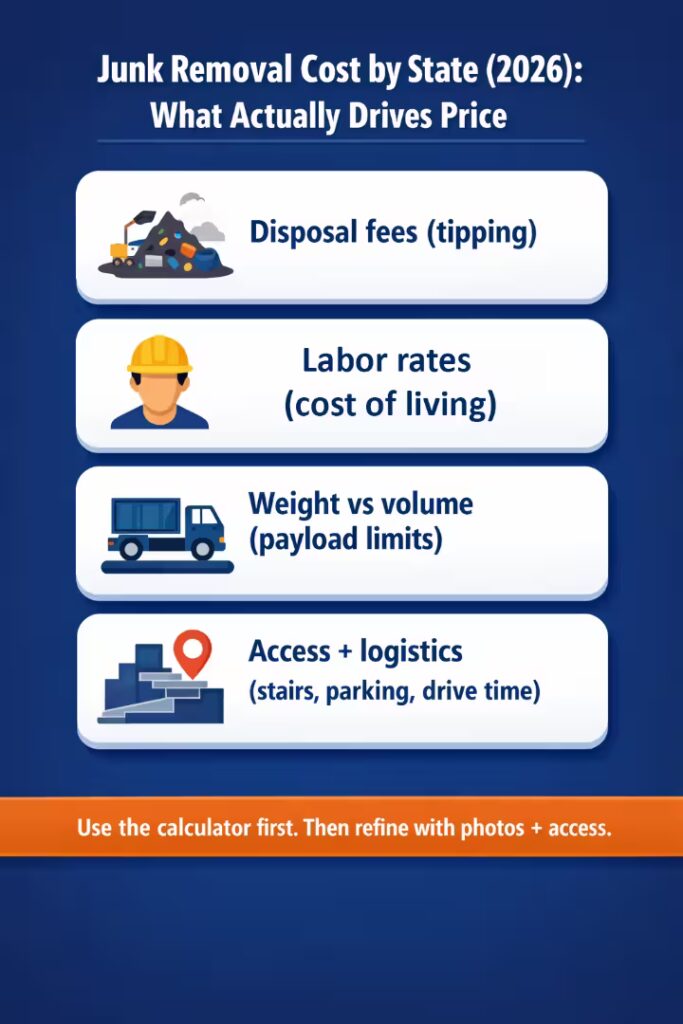
The 10-Second Reality Check (Before You Chase Quotes)
If you’re removing anything dense (tile, dirt, shingles, plaster, books, concrete, wet debris), your price is driven by weight, not “how big it looks.”
Fast rule:
If your pile would be miserable to carry in 5-gallon buckets more than ~10 trips, it’s not a “cheap” junk job.
Get Your State Price Now (Calculator)
Quick Chooser (Read This First)
Pick the situation you’re in and jump to the right section:
- I just want a rough price in my state → Use the calculator + state benchmarks below
- My pile is heavy (tile/shingles/dirt/concrete/books) → See “Heavy Junk Reality”
- I have mattresses/tires/fridge/TV/hot tub/safe → See “Surcharge Spectrum”
- Stairs / long carry / apartment rules / no parking → See “Access Multipliers”
- I’m comparing DIY vs dumpster vs full-service → See “Straight Comparison”
What This Index Actually Uses
A junk removal quote is basically:
Price = Labor + Truck + Fuel/Time + Disposal + Risk/Overhead
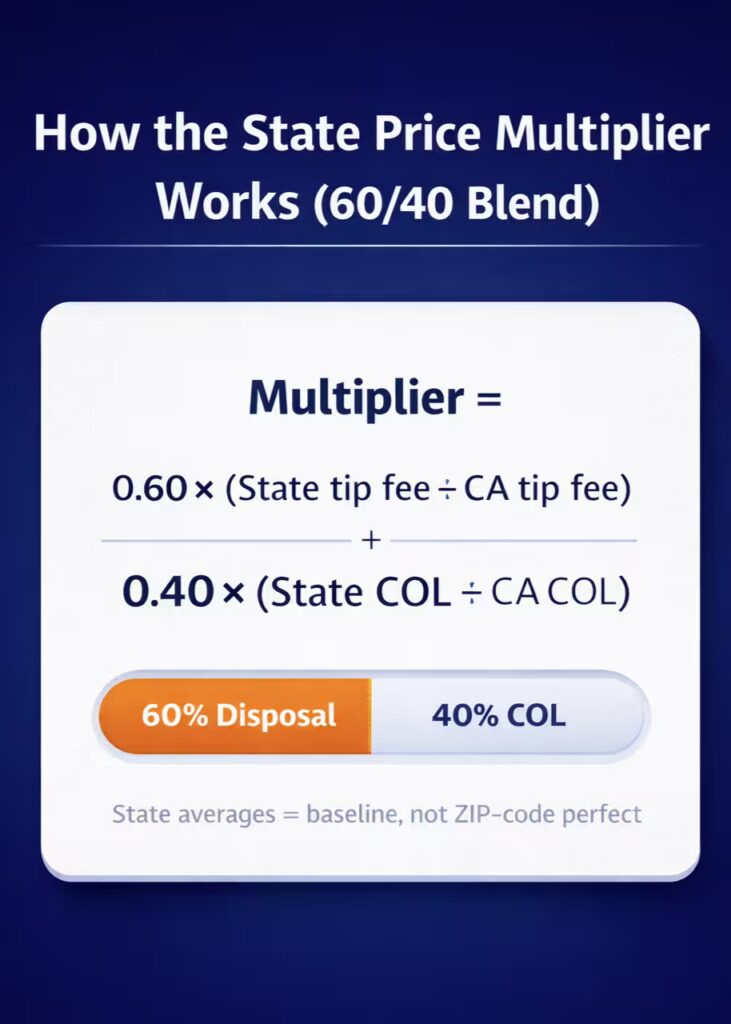
Across the country, two components swing the hardest:
- Disposal (dump) costs
- Labor costs (a good proxy is a cost-of-living / price-level index)
So the estimator uses a state multiplier that blends both.
Why disposal matters more than people think
Disposal is the hard floor. You can’t negotiate it away. You pay it every run.
Labor/overhead is the soft ceiling. Companies can optimize routing and staffing, but wages and operating costs still show up.
Plain truth: state averages are not ZIP-code perfect. They’re a baseline.
The calculator gets you into the right ballpark fast—then you refine with photos + access details.
Your Baseline Price Menu (The “Anchor”)
To turn a multiplier into a usable estimate, you need a baseline “typical” price menu.
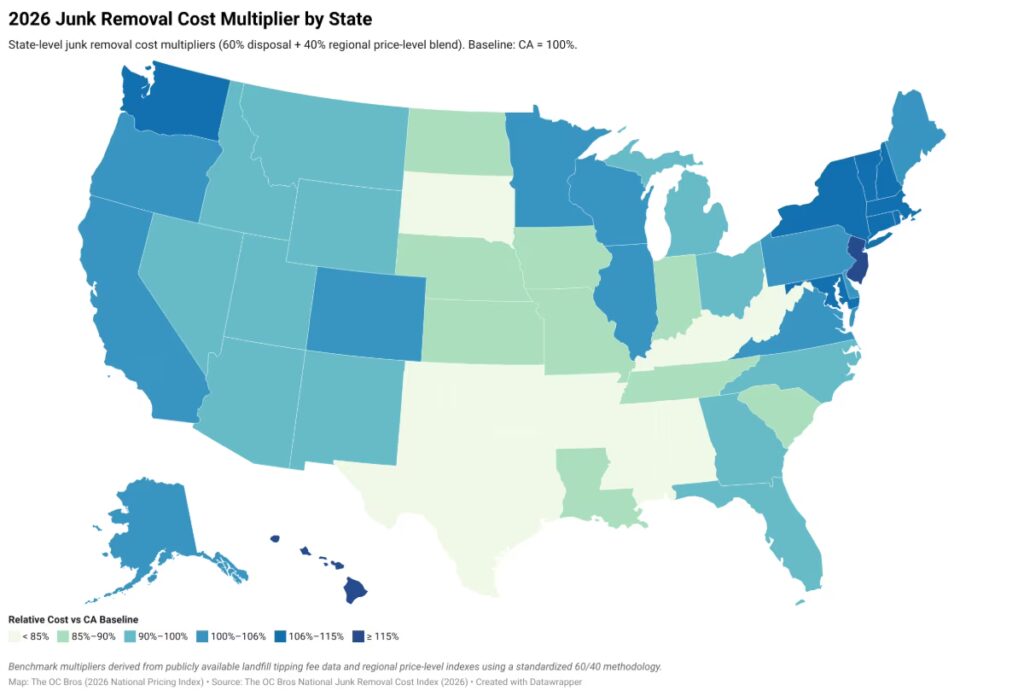
Prefer full screen? View the interactive map
This baseline assumes:
- full-service haul-away
- 2-person crew
- normal household junk (not heavy demo)
- easy access (driveway/curb/garage)
- disposal included
- no specialty items (see surcharges below)
Baseline Price Menu (CA = 1.00 anchor)
- Single item (chair, small dresser, microwave): $125–$225
- Small load (~1/8 truck): $100–$199
- 1/4 truck: $250–$400
- 1/3 truck: $300–$450
- 1/2 truck: $400–$600
- 3/4 truck: $600–$800
- Full truck: $700–$950+
Then the calculator applies your state multiplier to scale those ranges.
State Dump-Fee Benchmarks (The One Table Everyone Avoids Posting)
Most blogs dodge the one dataset that matters: state disposal (tipping) fee pressure.
So here it is.
Important context (don’t skip):
- These are state-level averages used for benchmarking, not guarantees.
- Many markets tip at transfer stations or processors, which can be higher than landfill gate rates.
- Some states need special handling (example: Connecticut isn’t a normal “in-state landfill pricing” market).
Full state table (average MSW disposal/tipping fee per short ton)
Tap to expand: State MSW tipping/disposal benchmarks (Avg $/short ton + year)
| State | Avg (USD/short ton) | Year(s) |
|---|---|---|
| Alabama | $32.93 | 2020 |
| Alaska | $142.33 | 2020 |
| Arizona | $44.89 | 2020 |
| Arkansas | $30.53 | 2020 |
| California | $58.48 | 2020 |
| Colorado | $58.42 | 2020 |
| Connecticut | $131.00 | FY2025 (Jul 2024–Jun 2025) |
| Delaware | $85.00 | 2020 |
| Florida | $56.51 | 2020 |
| Georgia | $47.88 | 2020 |
| Hawaii | $114.33 | 2020 |
| Idaho | $59.02 | 2020 |
| Illinois | $51.71 | 2020 |
| Indiana | $36.27 | 2020 |
| Iowa | $47.07 | 2020 |
| Kansas | $42.79 | 2020 |
| Kentucky | $36.32 | 2020 |
| Louisiana | $37.53 | 2020 |
| Maine | $75.21 | 2020 |
| Maryland | $66.73 | 2020 |
| Massachusetts | $95.00 | 2018 (EREF rev. ed.) |
| Michigan | $42.77 | 2020 |
| Minnesota | $57.78 | 2020 |
| Mississippi | $30.36 | 2020 |
| Missouri | $67.91 | 2020 |
| Montana | $32.06 | 2020 |
| Nebraska | $41.47 | 2020 |
| Nevada | $39.90 | 2020 |
| New Hampshire | $74.34 | 2020 |
| New Jersey | $78.80 | 2020 |
| New Mexico | $38.20 | 2020 |
| New York | $71.71 | 2020 |
| North Carolina | $45.97 | 2020 |
| North Dakota | $48.00 | 2020 |
| Ohio | $45.39 | 2020 |
| Oklahoma | $44.76 | 2020 |
| Oregon | $71.53 | 2020 |
| Pennsylvania | $73.45 | 2020 |
| Rhode Island | $115.00 | 2020 |
| South Carolina | $45.91 | 2020 |
| South Dakota | $51.22 | 2020 |
| Tennessee | $51.53 | 2020 |
| Texas | $45.15 | 2024 (TCEQ) |
| Utah | $33.80 | 2020 |
| Vermont | $101.95 | 2020 |
| Virginia | $53.43 | 2020 |
| Washington | $95.99 | 2020 |
| West Virginia | $54.66 | 2020 |
| Wisconsin | $61.00 | 2020 |
| Wyoming | $57.64 | 2020 |
How to use this table like a pro:
If your state’s disposal pressure is high, junk removal will feel expensive even before you factor in labor. And if you’re in a market that relies on transfer stations/export/WTE systems, your “dump cost” can diverge from the state average.
Why Your Real Dump Cost Can Be Higher Than the State Average
State averages often reflect landfill tipping fees, but many loads go through:
- transfer stations
- material recovery/sorting
- export or waste-to-energy routes
Those steps can raise the real disposal cost—especially in dense metros where landfills are far away or capacity is tight.
Translation: the benchmark table is a baseline, but your local routing can push the disposal portion up.
Real Examples (So You Can Sanity-Check Quotes Fast)
Your calculator output is the source of truth for your page—so use these examples as sanity checks, not gospel.
Example: 1/4-truck load (“garage corner / small room”)
- Low disposal + low cost-of-living states usually price well below coastal markets
- High disposal + high price-level states can price dramatically higher—even for identical piles
Example: 1/2-truck load (“partial garage / light move-out”)
Same logic, bigger swing:
- “Normal junk” scales fairly predictably
- Heavy/dense junk breaks the model fast (because weight limits kick in early)
Rule: If your pile is dense or includes specialty items, use the surcharge + density sections below before you trust any “by size” estimate.
The 4 Factors That Decide Your Price (That Most Blogs Ignore)
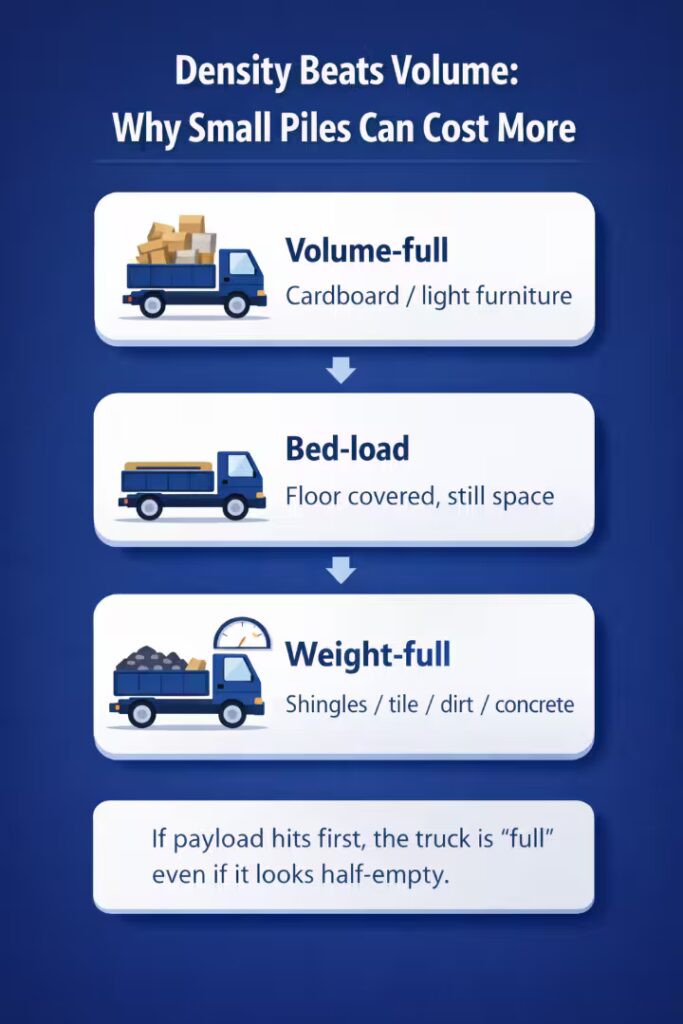
1) Density Beats Volume (Why Small Piles Can Cost a Lot)
A mountain of cardboard can be cheap.
A small pile of shingles can price like a living-room cleanout.
Why? Truck weight limits.
Once the truck hits its safe payload limit, it’s “full” even if it looks half empty.
Three “full” types you should know:
- Bed-load: the floor is covered, still vertical space
- Volume-full: the truck is physically packed
- Weight-full: you hit payload early (density)
If your load becomes weight-full, you pay like it’s bigger because:
- it may require a dump run sooner
- fuel/time increases
- disposal cost climbs fast
If you’re removing any of this, expect weight to drive price:
tile, dirt, shingles, plaster, concrete, bricks, wet trash, books/paper stacks, sandbags
2) The Surcharge Spectrum (Items That Trigger Flat Fees Almost Everywhere)
Some items don’t price like “normal junk” because processing is different or regulated.
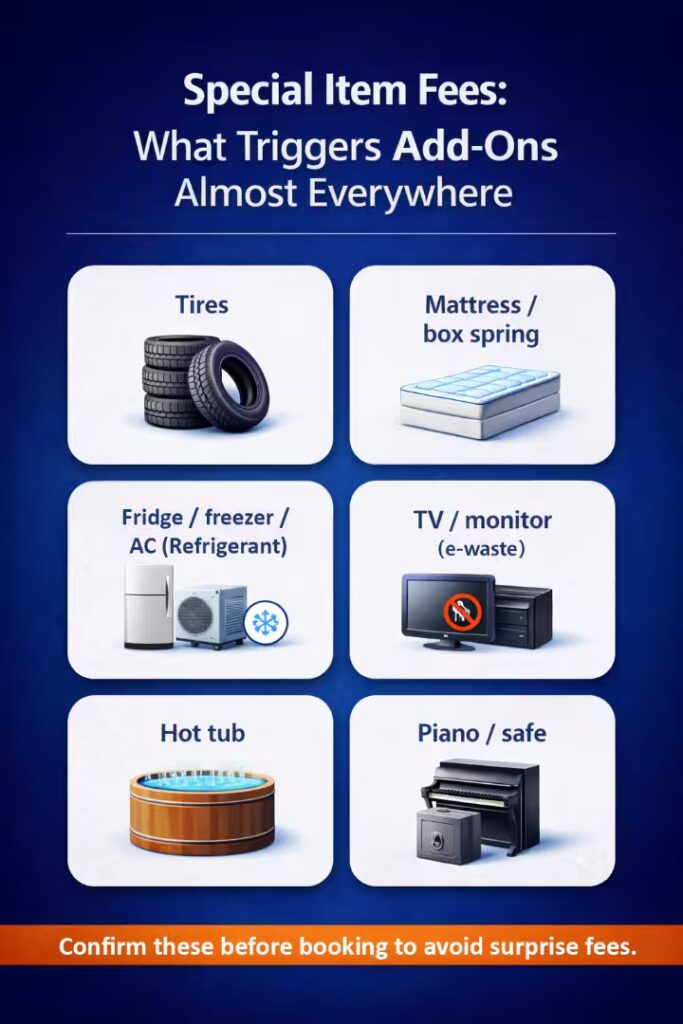
Cheat sheet: common surcharges
| Item | Why it costs more | What to expect |
|---|---|---|
| Tires | common landfill restrictions + special routing | per-tire surcharge is normal |
| Fridge / freezer / AC | refrigerant recovery + documentation | “Freon appliance fee” is often real |
| Mattress / box spring | many states fund recycling with fixed per-unit fees | per-mattress surcharge is extremely common |
| TVs/monitors (e-waste) | hazardous components, special processing | fee varies by size and route |
| Hot tubs | bulky + often needs cutting + labor | specialty-item quote |
| Pianos / safes | labor + risk + equipment | specialty-item quote |
If a company quotes a “too cheap” price on these, one of two things is happening:
- they’ll hit you with add-ons later, or
- they’re dumping it improperly (and you don’t want your address tied to that story).
3) Distance & Logistics (Why Rural Isn’t Always Cheaper)
Rural areas can have:
- cheaper labor
- cheaper disposal
…but higher logistics cost because:
- the dump is far
- route time eats labor hours + fuel
- jobs often need trailers/transfers/equipment
Big cities get expensive because:
- parking constraints
- elevator reservations / condo rules
- long carries
- tolls + traffic time
- tickets (yes, companies price this in)
Translation: a “cheap state” can still have expensive junk removal in certain counties because distance and access explode labor time.
4) Labor vs Disposal Ratio (Why Regions Feel Different)
You can explain national pricing patterns without guessing.
- Northeast: higher disposal + higher labor pressure
- Pacific/West Coast: labor pressure is high; disposal varies; regulation adds cost friction
- Midwest: moderate disposal + moderate labor
- South Central / parts of Southeast: often lowest disposal pressure (best value region)
- Mountains/Plains: disposal can be moderate, but logistics can spike
State Tiers (So You Understand the Landscape Fast)
Instead of a wall of numbers, here’s the economic clustering.
High-Cost Tier (often 1.25× and up)
Typically high disposal pressure, high price-level pressure, or both:
- Alaska, Hawaii, Washington, Vermont, Rhode Island, Connecticut, Massachusetts, etc.
Mid-Cost Tier (roughly 0.85× to 1.25×)
Most of the U.S. lives here—prices swing mainly by metro vs rural:
- Florida, New York, New Jersey, Pennsylvania, Colorado, Arizona, Illinois, Minnesota, Virginia, Oregon, etc.
Lower-Cost Tier (often under 0.85×)
Lower disposal pressure and/or lower price-level pressure:
- Mississippi, Arkansas, Alabama, Utah, Kentucky, Louisiana, Indiana, Nebraska, New Mexico, Montana, etc.
Use the calculator. It’s faster and more accurate than guessing.
What “Size” Really Means in Junk Removal (So You Don’t Get Played)
Most companies price by truck space, but honest pricing also factors:
- density/weight risk
- labor time (stairs, carry distance)
- special items
- sorting requirements (strict counties)
Practical “pile-to-load” guide (normal household junk)
- Single item: 1–3 small pieces
- 1/8 truck: small corner pile, small chair set, a few boxes
- 1/4 truck: typical garage corner, small room cleanout
- 1/2 truck: partial garage, medium cleanout, light move-out
- 3/4 truck: heavy cleanout or big garage purge
- Full truck: major cleanout, estate clear, multi-room purge
If your pile is dense, these categories compress fast. You hit weight-full before volume-full.
The Minimum Charge Nobody Mentions
Even if your pile is small, most pros have a real minimum because they’re paying for:
- crew dispatch time
- fuel + drive time
- loading + cleanup
- disposal routing
That’s why “just one item” still has a floor in many markets.
The “Check Your Quote” Checklist (5 Questions That Save You From Surprise Fees)
Ask these exactly:
- Is disposal included, and is it priced by weight or volume?
- What happens if the load becomes “full by weight” before it looks full?
- Any extra fees for mattresses, tires, appliances, or e-waste?
- Is there a fuel/travel surcharge (especially outside your core area)?
- Will I get a clear final number before you start loading?
If a company can’t answer clearly, the “cheap quote” is usually bait.
DIY vs Dumpster vs Full-Service (The Straight Comparison)
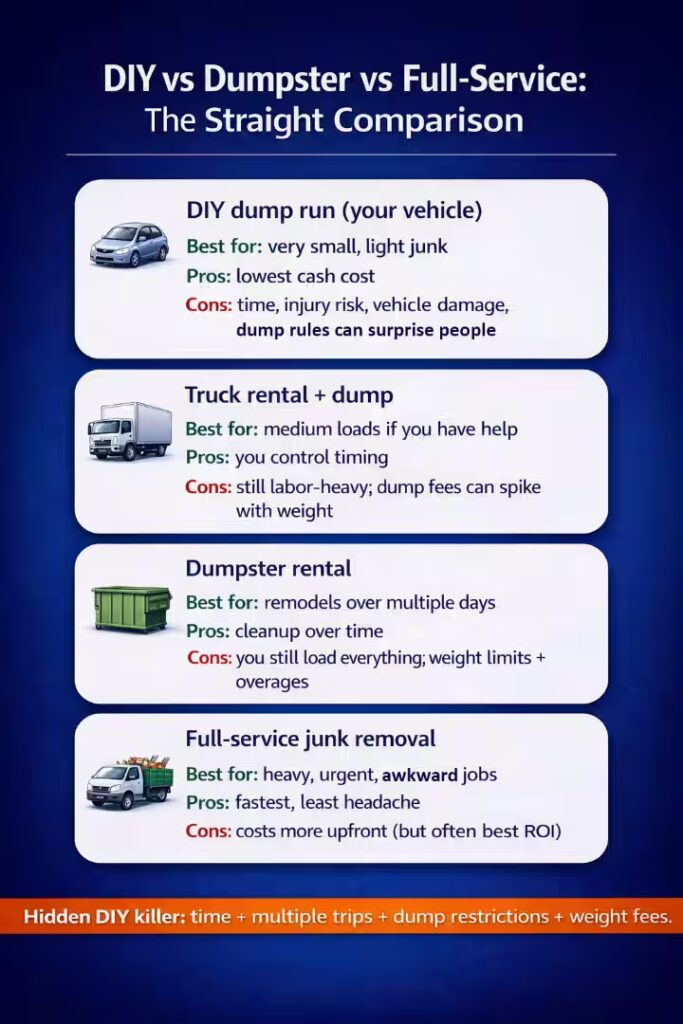
| Option | Best for | Pros | Cons |
|---|---|---|---|
| DIY dump run (your vehicle) | very small, light junk | lowest cash cost | time, injury risk, vehicle damage, dump rules surprise people |
| Truck rental + dump | medium loads if you have help | you control timing | still labor-heavy; dump fees can spike with weight |
| Dumpster rental | remodels over multiple days | cleanup over time | you still load everything; weight limits + overages |
| Full-service junk removal | heavy, urgent, annoying jobs | fastest, least headache | costs more upfront (but often best ROI) |
The hidden DIY killer: your time + multiple trips + unexpected dump restrictions + weight fees.
Donate vs Dump (When It’s Worth It)
If items are clean and usable, donation can reduce your disposal load and your price.
But donation centers often reject:
- damaged furniture
- mattresses
- heavily stained items
- particleboard that’s falling apart
If you’re on a deadline, donation runs can take longer than people expect.
Heavy Junk Reality (Read This If Your Pile Is Dense)
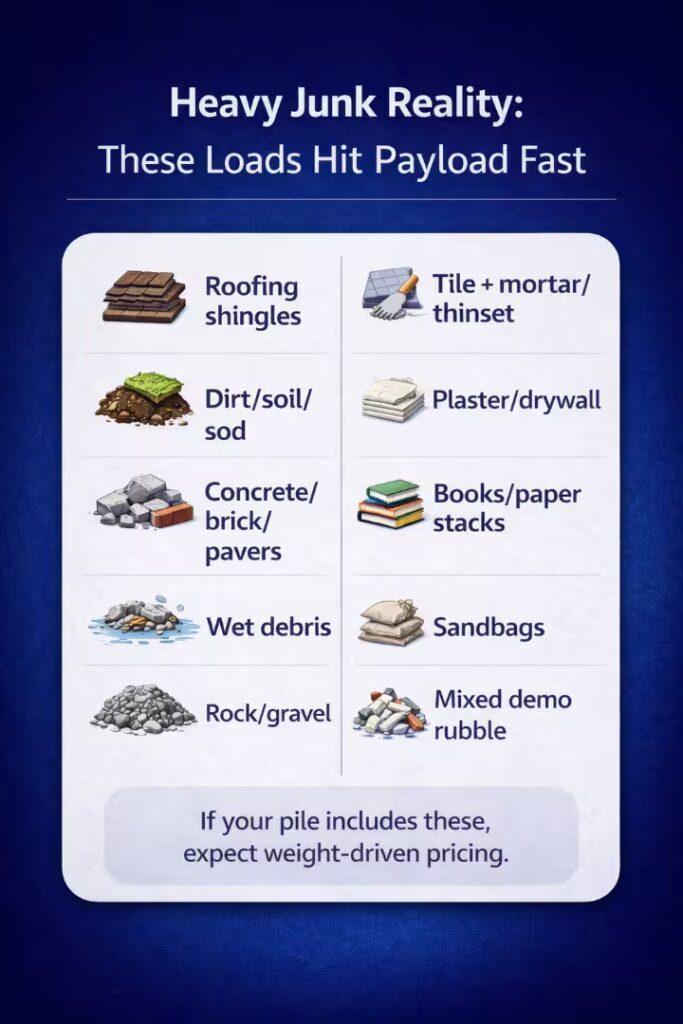
If your load includes any of these, think in weight, not size:
- roofing shingles
- tile + mortar/thinset
- dirt/soil/sod
- plaster/drywall chunks
- concrete/brick/pavers
- books/paper stacks
- wet debris (flood cleanouts, bagged wet trash)
Why it matters
Dense loads:
- take longer to load safely
- increase injury/damage risk
- hit weight limits early
- cost more to dispose of
- sometimes require a second run even if the truck looks “not full”
If you want the cheapest outcome with heavy junk
Do this:
- separate heavy debris from light junk
- stage heavy material close to where the truck parks
- ask for a quote specifically for a heavy-load rate (don’t let them price it like “normal junk”)
Access Multipliers (The Stuff That Quietly Adds $100–$400)
Two identical piles can price differently because of access.
Common time multipliers:
- stairs (multiple flights = real money)
- long carry (backyard → driveway)
- narrow hallways / tight turns
- elevator reservations / condo rules
- no parking / far street parking
- gated communities with strict windows
The 3 Photos That Get You the Most Accurate Price
Send:
- wide shot (shows total amount)
- close-up (shows material type + density)
- access shot (stairs, gates, hallways + where truck parks)
Optional but helpful:
- one photo of anything you think might be a surcharge (mattress, tire, fridge, TV, hot tub)
This reduces “on-site adjustment” risk.
Same-Day Pricing (When It’s Real and When It’s a Trap)
Same-day service is real, but it’s priced by logistics.
Same-day is easiest when:
- junk is staged in one spot
- access is easy
- you have photos ready
- it’s not heavy/demo debris
Same-day gets harder when:
- heavy materials are involved
- junk is spread across rooms
- upstairs + long carry
- parking is difficult
If someone promises same-day with no questions and a super low number, expect a messy surprise later.
Real Scenarios (So You Choose the Right Option)
Scenario A: “It’s just a few things.”
If it’s truly 1–3 light items and easy access, you should get a clean single-item price.
Scenario B: “Small pile of roofing or tile.”
This is where people get shocked. Small pile, heavy material → heavy-load pricing.
Scenario C: “Garage cleanout.”
Usually 1/4 to 1/2 truck unless you’ve got construction debris mixed in.
Scenario D: “Move-out junk.”
Prices swing based on stairs/elevator rules, staging, and mattresses/appliances.
Scenario E: “Hot tub / piano / safe.”
Don’t waste time chasing “general junk” quotes. You need a specialty-item quote.
What We Don’t Take (And Where To Go Instead)
Some materials don’t belong in a normal junk load—not because companies are being difficult, but because it’s regulated or dangerous.
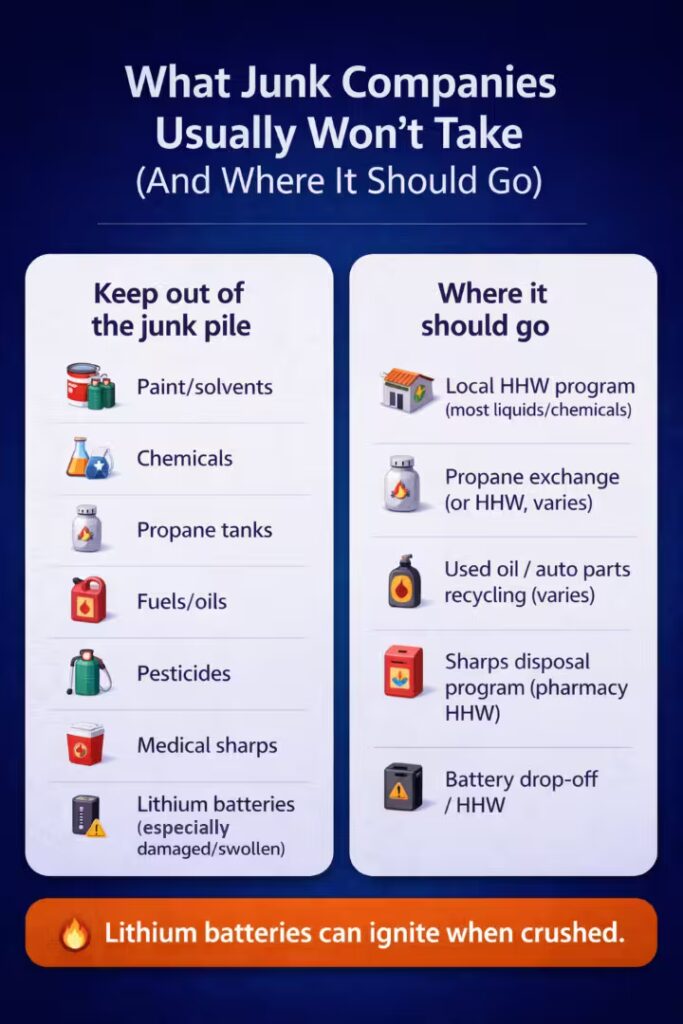
Common examples:
- paint, solvents, chemicals
- propane tanks (especially damaged/unknown)
- fuels, oils
- pesticides
- medical sharps
- lithium batteries (especially damaged/swollen)
- biohazard-contaminated items (including bug-infested mattresses)
Use your local HHW program, and if you want deeper guides:
- Lithium battery disposal: Lithium Battery Disposal Guide (2026)
- Paint disposal: Coming Soon
- Propane tank disposal: Coming Soon
- E-waste disposal: Coming Soon
Batteries (Especially Lithium) Are Not “Normal Junk”
Loose batteries are one of the biggest hidden problems in junk removal because damaged or loose lithium batteries can ignite when crushed, punctured, or bounced around in a truck.
That’s why many companies won’t take:
- loose lithium batteries
- swollen/damaged batteries
- large battery packs (e-bikes, scooters, tools)
Straight advice: keep batteries out of the pile and use proper drop-off routes.
For a step-by-step guide (including taping terminals and where to take them), see: Lithium Battery Disposal Guide (2026)
Mattress Reality Check (Bed Bugs + Biohazards)
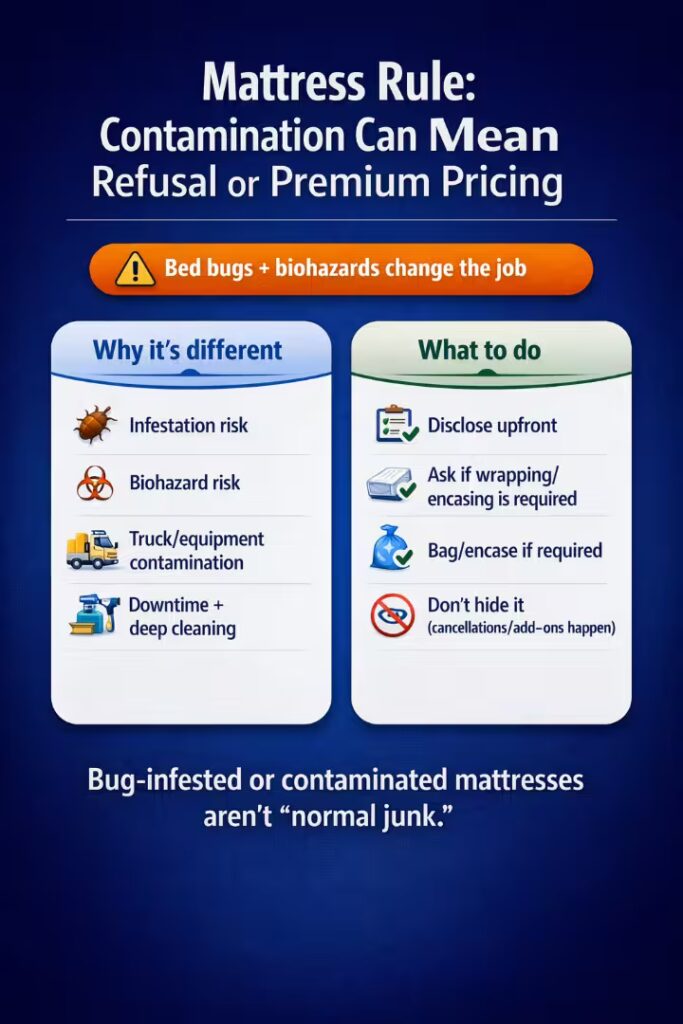
Mattresses are one of the most common “special category” items—and contamination changes the entire job.
If there’s any chance of bed bugs, fleas, bodily fluids, animal waste, mold, or other biohazard contamination, pricing can jump fast or the job can get declined entirely.
Why? Because one contaminated mattress can:
- infest a truck and equipment
- contaminate a shop/warehouse
- force deep cleaning, downtime, and lost revenue
- create a safety and liability problem for the crew
That’s why many companies either:
- turn away suspected/confirmed infestations, or
- require the mattress to be fully wrapped/encased (and charge more), or
- price it as a special handling item instead of “normal junk.”
Straight advice: disclose it upfront. If you hide it, you’re gambling with cancellations, extra fees, or a fight on-site.
Copy/Paste Quote Request (Gets Real Prices Fast)
Send this to any junk company:
“Hi, can you quote this for me? Is disposal included? Any extra fees for mattresses/tires/appliances/e-waste? Any special handling rules if a mattress is wrapped/encased or there’s any contamination risk? Access is [stairs/no stairs], carry distance is about [short/medium/long]. Truck can park [driveway / curb / street only]. Photos attached.”
This message saves you from 10 back-and-forth texts and kills surprise fees before they happen.
National Junk Removal FAQs
Bottom Line
If you want a real national answer to “how much does junk removal cost,” you have to account for:
- state disposal pressure
- state labor/price-level pressure
- weight vs volume
- access/time friction
- specialty item fees
- distance logistics
That’s exactly what the estimator is built to do.
IN ORANGE COUNTY?
This guide is national—but if you’re in Orange County and want this handled quickly, we can take it from here.
We’ll:
- confirm what counts as “normal junk” vs. specialty items (mattresses, tires, Freon appliances, e-waste)
- keep hazardous items out of the load (paint, chemicals, batteries, bulbs)
- give you a clear ballpark range from photos before we schedule
Text 3–5 photos + your OC city to (657) 776-2336 and we’ll reply with a ballpark range and the next available window.
Takes less than 2 minutes • No name, email, or credit card required
Sources & References
Last reviewed: February 14, 2026. The sources below document the primary data used to calculate state-level averages and explain national junk removal cost drivers. For full context, see each original source.
View sources, data & methodology
Sources & References
Last reviewed: February 13, 2026. We summarized the public sources below to explain the main cost drivers behind junk removal pricing (labor, disposal, compliance, fuel, and inflation). For full context, see each original source.
Landfill tipping fees (disposal costs)
- Environmental Research & Education Foundation (EREF) — 2024 Analysis of Municipal Solid Waste (MSW) Landfill Tipping Fees (benchmark report describing national/state tipping-fee patterns)
- Composting Technology — Landfill costs are tipping the scale toward composting (includes a reproduced state table; used for example state comparisons) *Note: this is a secondary reproduction; the EREF dataset/report is the primary source.
State landfill rate verification (facility-level pricing review)
- State Environmental Agencies (public rate schedules & facility lists) — Used to verify publicly posted MSW tipping fees at municipal and private landfills when calculating state averages. Examples include:
- CalRecycle (CA) — https://calrecycle.ca.gov
- Texas Commission on Environmental Quality (TCEQ) — https://www.tceq.texas.gov
- Florida Department of Environmental Protection (FDEP) — https://floridadep.gov
- New York State DEC — https://dec.ny.gov
- North Carolina DEQ — https://deq.nc.gov
- Georgia Environmental Protection Division — https://epd.georgia.gov
- Washington Department of Ecology — https://ecology.wa.gov
Cost-of-living / regional price levels
- U.S. Bureau of Economic Analysis (BEA) — Regional Price Parities (RPP): State and Metro Area (state-level price parity data used as a cost-of-living proxy)
Diesel fuel pricing (hauling cost pressure)
- U.S. Energy Information Administration (EIA) — Weekly Retail On-Highway Diesel Prices (used to contextualize transportation cost volatility impacting junk removal pricing)
Inflation (waste-service costs vs overall CPI)
- FRED (Federal Reserve Bank of St. Louis), sourced from BLS — CPI: Water and Sewerage Maintenance / Trash Collection Services (CUUR0000SEHG) (used for trash-service inflation trend)
- FRED (Federal Reserve Bank of St. Louis), sourced from BLS — CPI for All Urban Consumers (CPIAUCSL) (headline CPI used for comparison)
Labor context (material moving / general wage environment)
- U.S. Bureau of Labor Statistics (BLS) — Occupational Outlook Handbook: Hand Laborers and Material Movers (background context for the labor component of service pricing)
Truck weight limits / payload constraints (why “small piles” can price high)
- eCFR (U.S. Government) — 49 CFR §571.3 — Definitions (includes GVWR) (definition reference for Gross Vehicle Weight Rating)
- Cornell Law School (CFR mirror) — 23 CFR §658.17 — Weight limitations (federal roadway weight limit reference)
Tires (why tire surcharges exist)
- U.S. EPA (archive) — Basic Information: Scrap Tires (state landfill restrictions and handling context)
- U.S. EPA (archive) — Laws and Statutes: Scrap Tires (state fee program background)
- U.S. EPA — Used Tires — Quick Start Guide (PDF) (practical handling/disposal considerations)
Refrigerant appliances (“Freon” compliance)
- U.S. EPA — Appliance Disposal (Section 608) (refrigerant recovery responsibility and documentation)
- U.S. EPA — Section 608 Technician Certification Requirements (certification/compliance background)
Mattress recycling fees (state program examples)
- Mattress Recycling Council (MRC) — CA/CT recycling fee increase (effective Jan 1, 2025)
- Mattress Recycling Council (MRC) — California recycling fee adjustment (effective Apr 1, 2026)
- Mattress Recycling Council (MRC) — Rhode Island recycling fee increase (effective Jan 1, 2024)
- MRCReporting.org — Rhode Island program update (effective Jan 1, 2026)
Hazardous waste (what reputable haulers usually refuse / redirect)
- U.S. EPA — Household Hazardous Waste (HHW) (common HHW examples and safe disposal guidance)
- U.S. EPA — Household Hazardous Waste and Demolition (HHW examples encountered during cleanouts/demolition)
Construction & demolition waste context (C&D vs MSW pricing)
- U.S. EPA — Sustainable Management of Construction and Demolition Materials — Sustainable Management of Construction and Demolition Materials (used to clarify differences between MSW tipping fees and C&D waste streams)
Population density & urbanization context
- U.S. Census Bureau — Decennial Census & Population Data (used to explain why high-density states often show elevated disposal costs)
Landfill capacity & national MSW context
- U.S. EPA — Facts and Figures about Materials, Waste and Recycling — National MSW Data Reports (used to contextualize long-term system pressures that can influence regional disposal pricing)
Solid waste industry financial benchmarks
- Waste Business Journal (WBJ) — Industry reports on landfill consolidation, regional pricing power, and disposal market trends. Website: https://wastebusinessjournal.com (Referenced for market structure context; disposal pricing concentration in certain regions.)
Additional background (solid waste system economics)
National Academies — Report chapter on MSW / system costs (broad context used to support discussion of waste-management cost drivers)